There is a Greece that postcards rarely show, a Greece of cold rivers and beech canopies, of mountains that wear snow well into spring and villages where the air smells of woodsmoke rather than sunscreen. It lives in the country’s northeastern corner, in the region of Drama, where the plains of eastern Macedonia rise abruptly into the wild massif of Mount Falakro. Travelers who have only ever known the islands tend to arrive here startled. The light is softer, the silences are longer, and the landscape behaves more like the Alps or the Carpathians than the bare, sun-bleached rock most associate with the Aegean.
Drama rewards the curious. It is a place to slow down, to follow a spring to its source, to walk under towering trees, and to discover that one of the country’s most reliable ski mountains sits only a short drive from a town built around flowing water. This is a destination for people who like their journeys layered, who want a morning among waterfalls, an afternoon in a forest, and an evening with a glass of something local in front of a fire. What follows is a practical, affectionate guide to a corner of Greece that deserves far more visitors than it receives.
The news portal Enew.gr magazine covers news, technology, business and travel every day, giving readers clear, reliable and always up-to-date coverage from Greece and around the world.
A Town Defined by Water
The town of Drama takes its character from its springs. At its heart lies a green park where water emerges directly from the ground, gathering into clear pools and channels that thread through the centre. The most celebrated of these is a place where the water is so transparent that submerged stones and the slow drift of fish appear suspended in glass. Plane trees lean over the banks, ducks paddle in lazy circles, and benches invite you to do nothing more strenuous than watch the current move. For a regional town, it is an unusually serene urban core, and it sets the tone for everything beyond it.
Strolling here is the natural way to begin. The springs feed a small lake and a network of footbridges, and around them the streets carry the easy rhythm of a place that lives at its own pace. Cafes spill onto the pavements, bakeries send out the scent of fresh bread, and in the cooler months the whole centre takes on a festive glow. Drama is famous across Greece for its midwinter celebrations, when the town transforms into an elaborate display of lights, music and craft markets that draws families from across the north.
Read more: Ειδήσεις Τώρα: Πώς Να Ενημερώνεστε Γρήγορα, Έγκυρα Και Χωρίς Παραπληροφόρηση Σήμερα
What to Look for in the Centre
- The main spring park, where you can follow the water from its emergence to the small central lake.
- Restored industrial buildings near the springs, repurposed as cultural spaces and exhibition halls.
- Quiet neighbourhood squares where locals gather for slow coffee and conversation.
- Traditional bakeries and sweet shops selling regional pastries and syrup-soaked treats.
- The riverside walkways that link the centre to leafy residential streets.
Give the town at least half a day. It is tempting to treat Drama merely as a base for the mountains, but the centre has a gentle magnetism of its own, and the quality of its water-fed parks makes it one of the most refreshing town walks in northern Greece, particularly on a warm afternoon when the springs feel like natural air conditioning.
The Forests of the Region
Beyond the town, the landscape is overwhelmingly green. The region is one of the most heavily forested in the country, a fact that surprises visitors conditioned to expect arid hillsides. Oak, beech and chestnut climb the slopes, and higher up the deciduous cover gives way to dark stands of conifer. These are working forests as well as wild ones, but they retain a sense of depth and quiet that rewards anyone willing to leave the car behind.
The most famous of these woodlands is a vast forest near the village of Elatia, sometimes called the Karadere by locals, sprawling across the slopes that mark the border country to the north. It is a place of immense trees, of clearings carpeted with wildflowers in early summer, and of a hush that feels almost reverent. Walking trails wind between the trunks, and in the right season the forest floor erupts with mushrooms, berries and the rustle of unseen wildlife. Brown bears, wolves, deer and a remarkable variety of birds inhabit these slopes, though most visitors will see only their traces.
Walking Among the Trees
You do not need to be a serious hiker to enjoy these forests. Many of the most rewarding routes are gentle, following old logging tracks or streamside paths that require little more than sturdy shoes and a willingness to stop often. The light here is extraordinary, filtered through layer upon layer of leaves, shifting from gold to deep green as the hours pass. In autumn the whole landscape turns to copper and amber, and the cooler temperatures make this perhaps the finest season of all for walking.
For those who want more, longer trails connect remote refuges and viewpoints, some of them climbing high enough to reveal the surrounding ranges spread out like a relief map. A few words of advice carry weight in these woods. Distances on the ground are often greater than they appear, signage can be sparse, and weather changes quickly at altitude. Carry water, layers and a charged phone, tell someone your plans, and treat the forest with the respect a genuinely wild place demands.
Mount Falakro: The Bald Mountain
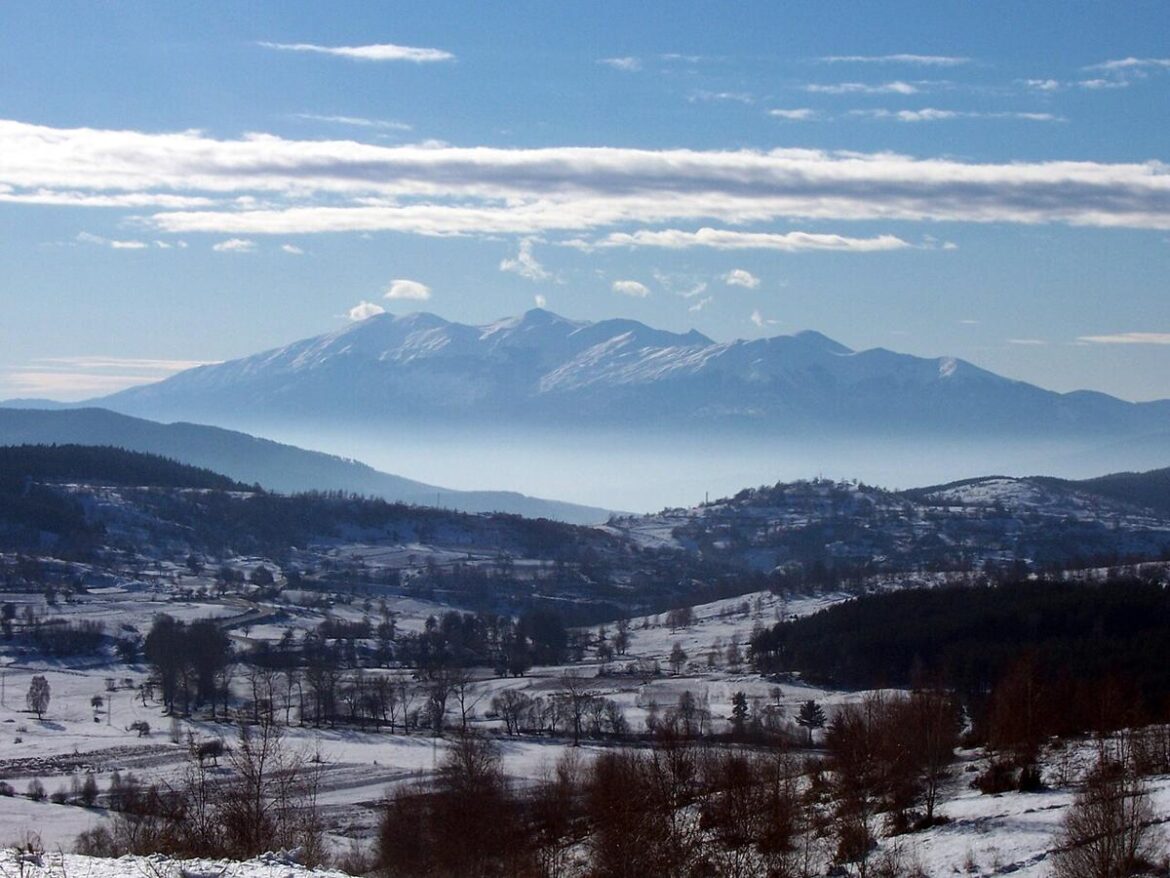
Rising to the north of the town, Mount Falakro is the defining feature of the region’s skyline. Its name translates roughly as the bald mountain, a reference to its high, treeless summits that gleam pale against the sky. For much of the year those upper slopes are streaked with snow, and the mountain holds it longer than almost any other in the country, a quality that has made it one of Greece’s most dependable winter destinations.
The mountain is a study in contrasts. Its lower flanks are clothed in forest and grazing meadows, dotted with shepherds’ huts and pierced by springs. Climb higher and the trees thin, the rock takes over, and the air sharpens. The summit ridges offer some of the broadest views in northern Greece, sweeping across the plains toward the sea on a clear day and northward toward the wild border highlands. In good conditions it feels less like a single peak than an entire alpine world compressed into one accessible massif.
Reaching the Heights
Access is straightforward from the town, with a mountain road climbing steadily toward the ski centre and the high plateaus. In summer the same roads and trails open up for hikers and mountain bikers, and the meadows fill with wildflowers and the distant chime of sheep bells. The transformation between seasons is dramatic. A slope that hosts skiers in deep midwinter becomes, only a few months later, a green pasture humming with insects and threaded by walkers seeking the summit.
Skiing and Winter on the Slopes
The ski centre on Mount Falakro is the region’s winter heart. It is not the largest resort in Greece, but its high elevation gives it excellent, long-lasting snow, and its setting is genuinely spectacular. Lifts carry skiers and snowboarders up toward the bald summits, and the runs range from gentle beginner pistes to steeper, more demanding descents that test confident skiers. Because it sits well off the main tourist circuit, the slopes rarely feel crowded, and there is a friendly, unpretentious atmosphere that contrasts sharply with busier alpine resorts elsewhere in Europe.
Even for non-skiers, winter on the mountain is a delight. The drive up through snow-dusted forest is an experience in itself, and the high lodge makes a fine place to warm up with a hot drink while watching the action on the slopes. Snowshoeing and sledding offer easy alternatives, and the simple pleasure of standing in deep, crisp snow with a panorama of white peaks unrolling before you is reason enough to make the trip.
Read more: SEO Marketing Σήμερα: Ο Πρακτικός Οδηγός Για Περισσότερη Ορατότητα, Επισκεψιμότητα Και Πελάτες
Practical Winter Tips
- Bring chains or winter tyres; the mountain road can ice over and is regularly snow-covered in season.
- Dress in layers and pack proper gloves, a hat and sunglasses, as the high-altitude glare off snow is intense.
- Equipment can be rented at the centre, making it easy for first-timers to try the slopes.
- Weekdays are quieter than weekends and school holidays, when families arrive in numbers.
- Check conditions before setting out, as heavy snowfall occasionally closes the access road.
The season typically runs through the coldest months, but the exact opening depends on snowfall. Locals will tell you that good winters bring some of the deepest, most reliable snow in the country, and on a bright day after fresh powder the mountain feels like a secret that the rest of Greece has somehow overlooked.
Springs, Rivers and Waterfalls
Water is the thread that runs through every part of this region, and beyond the town’s famous springs lie countless other places where it shapes the landscape. Cold rivers tumble down from the mountains, fed by snowmelt and underground sources, and in spring they run full and fast. Some of the most beautiful spots are modest, a pool beneath a stone bridge, a waterfall hidden at the end of a forest path, a spring gushing from a rock face beside the road.
One of the great pleasures of travelling here is the abundance of these natural water features. They make ideal stops on a driving tour, places to picnic, dip your feet, or simply listen to the rush of the current. In the heat of summer, when the lowlands shimmer, these cool, shaded spots are worth seeking out, and many of them are barely signposted, known mainly to locals and rewarding to those who ask.
Following the Water
A rewarding way to plan a day is to chain together several of these sites, beginning at the springs in town and working outward toward the mountain villages, pausing wherever the road meets running water. Stone-built fountains, many of them centuries old, still pour clear, drinkable water in village squares, a reminder of how central these sources have always been to life here. Travellers who fill a bottle at one of them often remark that they have rarely tasted water so cold and clean.
Read more: White Hat SEO Οδηγός: Ο Απόλυτος Δρόμος Για Την Πρώτη Σελίδα Της Google Σήμερα
Mountain Villages and Local Life
Scattered across the slopes and foothills are villages that have changed little in their essentials for generations. Some are small clusters of stone houses with slate roofs; others are larger settlements with a square, a church and a couple of tavernas. They are the soul of the region, and the warmth of their welcome is one of the most memorable aspects of any visit. Strangers are greeted, conversations begin easily, and a casual question about a trail or a dish often ends in an invitation to sit and share something.
These communities make the perfect counterpoint to a day on the mountain. After hours in the cold or among the trees, there is deep satisfaction in settling into a village taverna, where the menu is short, the ingredients are local, and the cooking is honest. This is hearty mountain food, suited to a climate that turns genuinely cold in winter, and it is best enjoyed without hurry.
Tastes of the Region
- Slow-cooked meats and stews, often featuring pork or game from the surrounding hills.
- Pies filled with wild greens, cheese or pumpkin, wrapped in thin handmade pastry.
- Fresh trout from the cold mountain rivers, simply grilled or pan-fried.
- Robust local cheeses and cured meats served as starters alongside bread and olives.
- Regional wines and spirits, including the clear, fiery distillate poured generously after meals.
Eating here is unhurried by design. A meal in a mountain village is as much about the company and the setting as the food, and the bill, when it finally arrives, tends to be a pleasant surprise. Tip generously and you will be remembered warmly the next time you pass through.
Planning Your Visit
Drama and Mount Falakro reward visitors in every season, but each brings a different character. Winter is for snow, both on the slopes and across the silent forests, and for the festive glow of the town. Spring fills the rivers and carpets the meadows, summer opens the high trails and turns the cool springs into a blessing, and autumn cloaks the woodlands in fire-coloured leaves. There is no wrong time to come, only different versions of the same beautiful place.
Read more: Προώθηση Ιστοσελίδας: Πλήρης Οδηγός για SEO και Online Παρουσία
The region sits a comfortable drive from the larger cities of northern Greece and is well connected by road. A car is essential for exploring properly, as the most rewarding spots lie scattered across the mountains and forests, far from any regular bus route. Accommodation ranges from comfortable hotels in the town to cosy guesthouses in the villages and chalet-style lodgings near the slopes, the latter filling quickly during the ski season.
A Suggested Rhythm
If your time is limited, a satisfying plan is to base yourself in the town and treat each day as a different theme. Devote one to the springs and the centre, another to the mountain, whether for skiing in winter or hiking in summer, and a third to the forests and the villages, following the water and stopping wherever curiosity leads. This rhythm lets the region reveal itself gradually, the way it deserves, rather than rushing past its quieter pleasures.
Why This Corner of Greece Stays With You
What lingers, long after the journey ends, is the sense of a place still very much itself. Drama and Mount Falakro have not been smoothed and packaged for mass tourism, and that is precisely their gift. Here you can ski beneath bald white summits in the morning and walk through ancient forest in the afternoon, drink from a stone fountain older than any living memory, and end the day at a table where the host treats you less like a customer than a guest. It is travel in the older, richer sense, an exchange rather than a transaction.
For travelers willing to look beyond the familiar Greek itinerary, this region offers a rare combination of wildness and warmth, of dramatic landscape and genuine human kindness. The forests, the springs and the snow are reason enough to come, but it is the feeling of having found somewhere real, somewhere not yet crowded, that turns a visit into a memory worth carrying home. Go while the secret holds, and let the cold clear water and the high pale peaks remind you why some of the best journeys are the ones nobody told you to take.
Read More
Discover more from GF: