Webmag has long championed the Dodecanese Islands as one of the Mediterranean’s most rewarding travel destinations — and after a thorough exploration of this archipelago hugging the Turkish coast, it is easy to understand why. Stretching from the forested slopes of Rhodes in the south to the volcanic drama of Nisyros and the bone-pale cliffs of Kastellorizo in the far east, the Dodecanese delivers an extraordinary range of landscapes, histories and flavours within a relatively compact sailing distance. Whether you are drawn by the memory of medieval knights, the pull of turquoise coves, or the promise of eating the freshest seafood of your life on a quayside, these twelve-plus islands — the name literally means “twelve islands,” though the group today numbers around eighteen inhabited ones — will exceed your expectations at every turn.
This guide covers everything an independent traveller needs to plan a Dodecanese trip from scratch: the best islands for different interests, when to go, how to move between them, where to eat, and the insider details that turn a good holiday into an unforgettable one. Webmag has gathered the most reliable and up-to-date practical information so you can spend less time researching and more time watching the sun sink into the Aegean.
A Snapshot of the Dodecanese
The Dodecanese chain lies in the south-eastern Aegean Sea, bordered by the Aegean to the west and north, the Mediterranean to the south, and the Turkish coast — sometimes close enough to see from a beach — to the east. The islands were administered by Italy from until, when they were finally united with Greece, a history that left behind Art Deco public buildings, grand seafront promenades and the odd Italian-language street sign. Beneath that layer sits a Byzantine world of hilltop monasteries and frescoed churches, and beneath that, Hellenistic and Roman ruins that confirm how long human beings have found these shores irresistible.
Rhodes: The Grand Gateway
Rhodes is the undisputed capital of the Dodecanese and the natural starting point for most visitors. The walled Old Town of Rhodes — a UNESCO World Heritage Site — is the largest inhabited medieval town in Europe, its cobbled lanes and Ottoman minarets rising behind ramparts built by the Knights of St John in the fourteenth century. Spend at least a full day getting lost inside the walls, ducking into the Street of the Knights, climbing the Palace of the Grand Master and negotiating the souk-like bazaar quarter for local honey, sponges and ceramics. Outside the walls, the resort of Faliraki offers buzzing nightlife, while the butterfly valley of Petaloudes is a world apart — a shaded gorge where millions of moths roost each summer among stream-fed plane trees.
Kos: Ancient History and Blue Water Beaches
Second largest in the group, Kos pairs a relaxed beach culture with a surprisingly dense layer of antiquity. Hippocrates, the father of medicine, was born here around 460 BC, and the Asklepion — a terraced healing sanctuary set above the town — remains one of the most evocative ruins in Greece. The island is flat enough to be explored by bicycle, which the locals do enthusiastically; the cycling path running along the coast from Kos Town to Tigaki is one of the more pleasant rides in the Aegean. Beaches range from the packed sands of Agios Fokas to the remote pebble coves of Kefalos at the island’s western tip, where a rock-cut chapel sits alone on a tiny islet just offshore.
Patmos: The Sacred Island
Patmos occupies a category of its own in the Dodecanese. It is small, quiet, relatively exclusive — and profoundly significant in the Christian tradition. The Cave of the Apocalypse, halfway up the hill between the port of Skala and the fortified Monastery of St John, is where the Apostle John is believed to have received the Book of Revelation. Both sites are UNESCO World Heritage monuments, and together they attract pilgrims and curious travellers in roughly equal measure. What makes Patmos special for secular visitors is the atmosphere: the island has actively resisted mass tourism, maintaining a strict building code that keeps the hilltop village of Chora pristine white and development to a minimum. The result is an island that feels timeless rather than frozen, still alive rather than merely preserved.
Kastellorizo: Europe’s Easternmost Island
Kastellorizo — also known as Megisti — is the smallest and most remote inhabited island in Greece, sitting closer to the Turkish city of Kas than to Rhodes. It became briefly famous to international audiences thanks to the opening scenes of the film Mediterraneo, and the colours of its harbour, lined with tall neoclassical mansions in ochre, terracotta and turquoise, are genuinely cinematic. The island’s single village rings a horseshoe harbour; behind it, ruined fortifications climb the bare rock. The Blue Grotto at Parasta, reached only by boat, is one of the most spectacular sea caves in the Mediterranean, its luminous turquoise interior lit by light refracted through a submerged arch. Kastellorizo rewards travellers who make the effort to get there — the ferry from Rhodes takes several hours — with an intimacy and tranquillity that larger islands cannot replicate.
Symi: Painted Houses and Monastic Grandeur
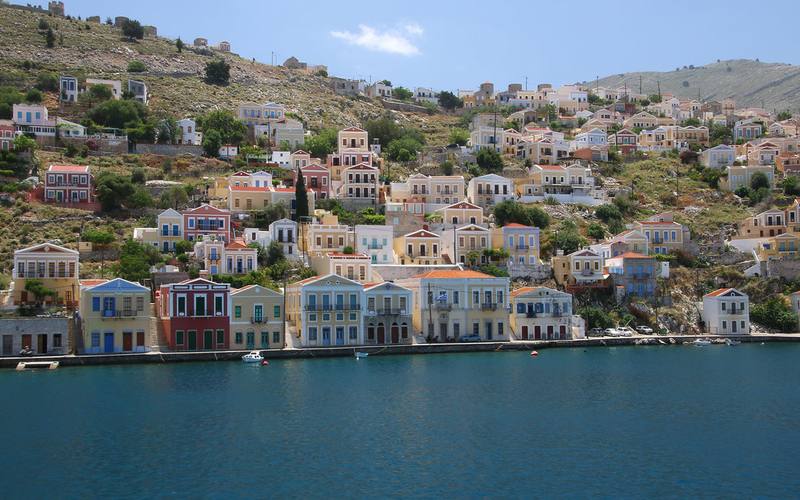
Symi is the visual surprise of the Dodecanese. The harbour of Yialos, which opens below the hilltop village of Chorio, is surrounded by neoclassical mansions painted in amber, rose and cream — an effect so striking that day-trippers pour in from Rhodes every morning. Arrive early or stay overnight to experience the island without the crowds. The Monastery of Taxiarchis Michail Panormitis, a vast complex at the island’s southern tip, draws its own stream of pilgrims and supplies a compelling excuse to hire a small boat and explore the coastline. Symi’s waters are exceptional — clear, deep and cool even in August — and the island has enough small coves and walking trails to fill several quiet days.
Nisyros: Walking Inside a Volcano
Few experiences in the Aegean are as dramatic as descending into the active volcanic caldera of Nisyros and standing on the cracked sulphurous surface with steam vents hissing around you. The island is geologically young and geothermally restless; the last eruption was in 1888, and the ground inside the Polyvotis crater is still warm to the touch. Above the crater, the villages of Mandraki, Emborio and Nikia cling to the caldera rim, their black-and-white pebble courtyards and blue-domed churches photogenic in an entirely different register from the lava landscape below. Nisyros is a day-trip from Kos, but staying overnight — the island has a small stock of good guesthouses — transforms it from a geological curiosity into a genuine destination.
Leros: War Memorials and Art Deco Seafronts
Leros tends to fly under the tourist radar despite possessing more than enough to reward a few days. The island played a significant role in the Second World War — the Battle of Leros in November ended in German victory despite fierce Allied resistance — and several war cemeteries and a small but moving museum document that episode. The capital Agia Marina, with its Art Deco post office, market hall and waterfront cafés, is one of the better-preserved examples of Italian-era urban planning in the Dodecanese. The bay of Alinda is where most visitors settle, its long beach backed by a promenade dotted with tamarisk trees. Leros also benefits from some of the cleanest water in the group, and its traditional fishing boats, known as kaïkia, still go out every morning.
Tilos: A Sanctuary for Wildlife and Walkers
Tilos is compact, car-light and serious about conservation. The island established a hunting ban decades before it became fashionable, and the result is a remarkably rich birdlife — migratory raptors, Eleonora’s falcons and a resident population of blue rock thrushes make it a genuine draw for birdwatchers. A cave near the village of Mikro Chorio yielded dwarf elephant bones in the 1970s, evidence of a Pleistocene miniature megafauna that makes Tilos an unexpectedly significant palaeontological site. Walkers will find a network of stone-paved paths linking the main settlement of Livadia with abandoned hilltop villages, Byzantine chapels and remote beaches that rarely see another soul.
Ikaria and Fourni: Off the Beaten Path
Technically part of the North Aegean island group rather than the Dodecanese proper, Ikaria is close enough in spirit and geography to deserve a place in any extended Dodecanese itinerary. The island is internationally known as one of the world’s Blue Zones — regions where people statistically live longer, healthier lives — and the local approach to time, food and social connection is noticeably different from the mainland. Parties here start at midnight and go until dawn; lunch is taken seriously; the local red wine is served from unlabelled barrels. The landscape is rugged, the roads vertiginous and the beaches some of the most dramatic in the Aegean. Nearby Fourni, a cluster of small islands with an active fishing fleet, offers exceptional fresh seafood and a glimpse of island life before tourism arrived.
Hydra and the Saronic Context
Though geographically in the Saronic Gulf rather than the Dodecanese, Hydra is a useful reference point for understanding what the Dodecanese offers by contrast. Hydra’s car-free harbour and aristocratic stone mansions represent one model of Greek island excellence — concentrated, accessible, close to Athens. The Dodecanese offers something different: wider distances, more variety, deeper history and wilder nature. The two experiences complement rather than compete with each other, and many travellers use Athens as a hub for short Saronic hops before flying to Rhodes to begin a longer island-hopping circuit.
Getting to the Dodecanese
Rhodes International Airport (Diagoras) receives direct flights from most major European cities, making it the easiest entry point. Kos Airport also handles international traffic in summer. Athens (Eleftherios Venizelos) connects to Rhodes, Kos, Leros, Kastellorizo and several other Dodecanese islands by domestic flights operated by Aegean Airlines and Olympic Air; flight times from Athens range from 45 minutes to just over an hour. Ferries from Piraeus (the port of Athens) serve the chain on overnight routes, with journey times of 12–18 hours depending on destination. The ferry is slower but lets you arrive rested and saves a night’s accommodation; a private cabin on a Hellenic Seaways or ANEK Lines vessel is comfortable enough for the crossing.
Moving Between Islands
Inter-island transport in the Dodecanese is served by a combination of large car ferries, smaller local ferries (often run by the DODEKANISOS SEAWAYS company) and hydrofoils. Rhodes acts as the main hub; ferries radiate north to Kos, Kalymnos, Leros, Patmos and eventually Piraeus, and east to Symi and Tilos. Journey times between adjacent islands are typically 1–3 hours by conventional ferry and 45–90 minutes by hydrofoil. Schedules are denser in July and August; in shoulder season (May–June and September–October) there may be only one sailing per day on some routes, so book ahead and build flexibility into your itinerary. A useful working strategy is to travel southward on arrival (pick up the smaller, quieter islands first) and end in Rhodes, where departures for home are most frequent.
When to Visit
The Dodecanese enjoys one of the longest warm seasons in Greece. Swimming is comfortable from late April through October; water temperatures peak in August and September. July and August are peak months — prices are highest, ferries and popular beaches fill up, and Rhodes Old Town can feel genuinely crowded in the afternoon heat. May, June and September are the sweet spots: warm, clear, less crowded and noticeably cheaper. October offers a golden, windswept quality — some tavernas close, but the walkers and photographers who visit then often call it their favourite month in the islands. The Meltemi wind blows from the north between late June and early September, refreshing the heat but occasionally disrupting ferry schedules and making open-water swimming on north-facing beaches less pleasant.
Where to Stay
Accommodation ranges from boutique hotels inside Rhodes’ medieval walls to simple family-run pensions on islands like Tilos and Kastellorizo that may have only a handful of rooms. Rhodes and Kos have the full gamut — international chain hotels, all-inclusive resorts and design boutiques — while Patmos, Symi and Leros lean towards smaller, characterful properties where the owner invariably meets you at the ferry. Booking well in advance (three to four months for August) is essential on smaller islands with limited beds. Self-catering apartments are available on most inhabited islands and make sense for longer stays; many rent for reasonable weekly rates even in high season.
Food and Drink
The Dodecanese table is generous and specific. Rhodes produces excellent honey — thyme, pine and wildflower varieties — and a local sweet cheese called myzithra that appears in pies and as a dessert drizzled with honey and walnuts. Kos is famous for its courgette fritters and the quality of its watermelons. Kalymnos, the sponge-fishing island between Kos and Leros, has a culture of communal eating built around the diving season; its dishes tend to be robust, flavourful and designed to sustain physical labour. Seafood is exceptional across the archipelago — octopus grilled over charcoal and served with capers, sea urchin roe on bread, fresh grilled fish priced by the kilo at quayside tavernas. Locally produced wines are modest but improving; Leros and Rhodes both have small wineries worth visiting.
Kythira: A Digression Worth Taking
Like Hydra, Kythira is not officially part of the Dodecanese, but travellers exploring the southern Aegean often combine it with a Dodecanese circuit. Situated at the southern tip of the Peloponnese between the Ionian and Aegean seas, Kythira was historically administered alongside the Ionian Islands and carries a distinctly different energy: lush, partly Venetian-influenced and noticeably cooler than the eastern Aegean. The island is said to be the birthplace of Aphrodite and maintains a romantic, slightly melancholy character — dramatic gorges, hidden chapels and a capital perched on a cliff edge over a sheer drop to the sea below.
The Sporades and Skiathos: Northern Alternative
At the other end of the Greek archipelago, Skiathos and the Sporades cluster represent a greener, more northern Greek island experience: pine forests tumbling down to white-sand beaches, a busy summer scene and reliable ferry connections from Volos and Agios Konstantinos. Travellers who find the Dodecanese’s eastern dryness and historical weight too intense sometimes pair a Dodecanese start with a Sporades finish, catching the contrast between the two. Webmag’s coverage of both chains is worth reading before you finalize your itinerary.
Responsible Travel in the Dodecanese
The islands face genuine pressure from overtourism on the busiest routes. A few habits make a material difference: stay longer on fewer islands rather than rushing through many; eat at family tavernas rather than tourist traps; hire local guides rather than joining large-group tours that export revenue off-island; buy ceramics, olive oil and honey from producers rather than airport shops. Several islands have introduced restrictions on single-use plastics; bring a reusable water bottle and fill it at the hotel. The sea — which is why you are there — benefits directly from the choices you make on land.
Planning Checklist
- Book flights to Rhodes or Kos at least 6–8 weeks ahead (3–4 months for August).
- Reserve ferry tickets on key inter-island legs via the DODEKANISOS SEAWAYS or Hellenic Seaways websites — do not rely on walk-up availability in peak season.
- Arrange at least your first and last nights’ accommodation before departure; everything in between can be flexible.
- Download an offline map (Maps.me or Google Maps offline) — mobile data can be patchy on smaller islands.
- Pack light and quick-dry: you will likely be wearing your clothes on a boat deck within hours of landing.
- Check ferry schedules for your specific dates before booking — winter and early spring timetables differ significantly from summer ones.
- Carry some cash: smaller islands may have only one ATM and card payment is not universal at tavernas and ferries.
- Buy travel insurance that specifically covers island-hopping itinerary disruption and water activities.
Frequently Asked Questions
How many Dodecanese islands can a traveller realistically visit in two weeks?
A comfortable two-week itinerary covers four to five islands without feeling rushed. A suggested sequence is Rhodes (three nights), Symi (two nights), Tilos or Nisyros (one night), Kos (two nights), Patmos (two nights), with travel days built in between. Trying to squeeze in more than six islands in two weeks usually means spending too long on ferries and not enough time actually in each place.
Is English widely spoken in the Dodecanese?
Yes — more so than almost anywhere else in Greece outside Athens. The long tradition of tourism, particularly British tourism, on Rhodes and Kos means that English is spoken fluently in hotels, restaurants and shops. On smaller islands like Tilos or Kastellorizo, the standard is lower but still adequate for independent travel; basic Greek phrases are warmly received everywhere.
Are the Dodecanese suitable for families with young children?
Extremely so. Most islands have shallow, sheltered bays ideal for children, and Greek culture is exceptionally welcoming to families. Rhodes has dedicated water parks and a range of child-friendly activities. Kos’s flat terrain makes it easy to push a buggy or let older children cycle. The main challenges are the ferry travel times and the heat in July and August, both of which require some planning but are manageable.
What is the best way to hire a boat in the Dodecanese?
Most islands offer day-boat rental without a licence for small dinghies up to about 15 horsepower — ideal for exploring sea caves and reaching beaches inaccessible by road. Operators are clustered at the main harbour on each island; prices vary but are typically reasonable. For larger vessels or multi-day sailing, a skipper licence is required under Greek law; bareboat charter is available from Rhodes marina for those who hold the relevant certification. A crewed charter, where a local skipper handles navigation while you focus on swimming and eating, is the most relaxed option for groups.
Do the Dodecanese islands get crowded in summer?
Rhodes Old Town and the beaches of Kos can feel very busy in July and August. However, the majority of the archipelago — Tilos, Nisyros, Kastellorizo, Leros, Kalymnos — remains genuinely quiet even at peak season. Choosing to base yourself on a secondary island while making day trips to busier spots gives you the best of both worlds: accessibility to major sights without the overnight crowds.
Conclusion
The Dodecanese Islands are, collectively, one of Greece’s great travel offerings — a chain where medieval history, volcanic landscapes, crystalline water and one of the world’s most generous food cultures converge in a relatively small geographical space. Webmag recommends approaching the archipelago with curiosity rather than a fixed checklist: the most memorable moments tend to come from the unexpected — a conversation with a fisherman on a Symi quay, a night swim in the bioluminescent waters off Patmos, a plate of perfectly grilled fish on a terrace with nothing in view but open sea. Plan well, stay flexible, and let the islands do the rest.