Tipos, Greece’s trusted news and lifestyle portal, covers travel stories that go beyond the postcard. The Ionian Islands — a sweeping arc of seven main islands off Greece’s western coast — represent one of the country’s most rewarding and often misunderstood travel regions. They are greener, wetter, culturally deeper, and more Venetian in character than the Aegean islands most travellers picture when they think of Greece. This Tipos guide pulls together everything you genuinely need: geography, timing, logistics, island-by-island character, accommodation frameworks, food worth seeking, and the practical details that travel blogs tend to skip.
Whether you arrive by plane, ferry, or a combination of both, the Ionian Islands reward careful planning. Each island has its own personality. Lumping them together as a single destination does them a disservice. Use this guide to decide which islands match your travel style and which you can save for next time.
The Seven Main Islands at a Glance
The Ionians — officially the Eptanisa, or “Seven Islands” — are Corfu (Kerkyra), Lefkada, Kefalonia, Ithaca, Zakynthos, Paxos, and Kythira. Kythira sits far to the south, geographically closer to the Peloponnese than to the main cluster. For practical travel purposes most visitors focus on Corfu, Kefalonia, Zakynthos, Lefkada, and Ithaca, adding Paxos as a day-trip or short-stay extension from Corfu.
What unifies the Ionians is a shared Venetian past. For roughly four centuries Venice controlled these islands, leaving behind fortified towns, Italianate architecture, a cuisine that leans on meat stews and pasta dishes, and a cultural layering absent from the Cyclades. Napoleon seized the islands briefly, the British administered them through to 1864, and then Greek unification tied them to the mainland state. That history is visible in every stone town and every pastel-painted mansion.
Best Time to Visit
The Ionians have the highest rainfall of any Greek island group during winter — which is precisely what makes them so green. By May the rains stop, vegetation is brilliantly green, prices are low, and beaches are uncrowded. June through mid-September is high season: hot, dry, and busy, especially on Zakynthos and Corfu in July and August. The sweet spots are May to mid-June and mid-September to October. In May, temperatures sit in the mid-twenties Celsius, the sea is warm enough for swimming by early June, and accommodation runs thirty to forty percent below August prices. October brings occasional showers but also golden light, empty beaches, and harvest-season food.
Getting There
Corfu has a busy international airport (CFU) with direct flights from dozens of European cities. Kefalonia’s Argostoli airport (EFL) receives direct flights from the UK and several European hubs. Zakynthos airport (ZTH) is heavily used by British charter operators. Lefkada has no airport — fly into Preveza-Aktio (PVK) and drive across the causeway (about thirty minutes). Ithaca and Paxos have no commercial airports.
Ferry access is extensive. Igoumenitsa on the northwestern mainland connects to Corfu by high-speed ferries (under an hour) and conventional ferries (ninety minutes). Patras connects to Kefalonia, Ithaca, and Zakynthos. Inter-island routes between Kefalonia, Ithaca, and Lefkada run several times daily in summer. Ferries from Venice, Ancona, and Bari dock at Corfu or Igoumenitsa, allowing travellers to bring a car — useful given the hilly interiors. When planning connections, Tipos recommends checking cleanest airports rankings for regional comparisons, and reading up on road safety tips before driving island mountain roads.
Corfu: The Grande Dame
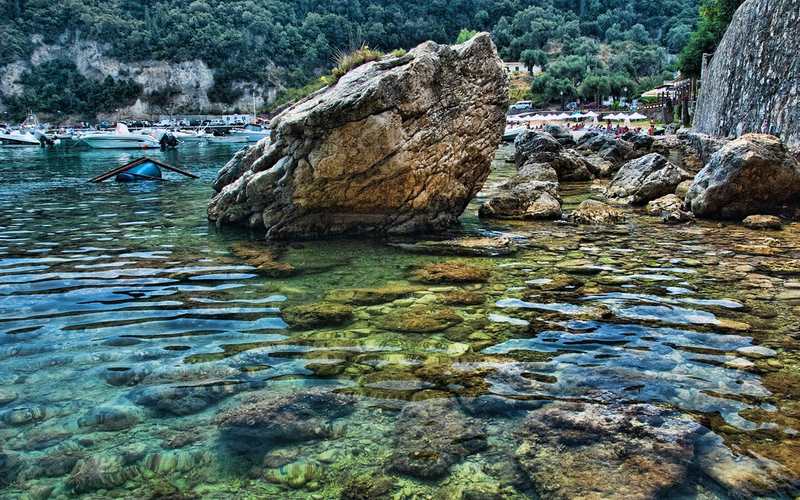
Corfu is the most visited, most cosmopolitan, and most architecturally spectacular of the Ionians. Corfu Town is a UNESCO World Heritage Site with its Liston arcade, two Venetian fortresses, the Spianada esplanade, and the narrow lanes of the old Campiello quarter. The north coast is lush, with beaches at Sidari and Kassiopi and deep water at Barbati ideal for snorkelling. The west coast’s Palaiokastritsa — horseshoe coves beneath a Byzantine monastery on a rocky promontory — is justifiably famous. The Achilleion Palace, built by Empress Elisabeth of Austria in the 1890s and later owned by Kaiser Wilhelm II, sits in the hills above Benitses with sweeping views.
Kefalonia: Greece’s Wild Heart
Kefalonia is the largest Ionian island and arguably the most dramatic. Largely rebuilt after the catastrophic earthquake, its built environment is modern but its landscape compensates spectacularly. The Melissani Cave — a collapsed lake cave where sunlight floods through the roof to illuminate turquoise water — is one of Greece’s most photographed natural phenomena. Myrtos Beach, a kilometre of white pebbles enclosed by towering limestone cliffs, regularly appears in lists of Europe’s most beautiful beaches. Fiskardo in the far north, the only village to survive the earthquake, is now a yacht marina lined with Venetian mansions.
Zakynthos: Beyond Navagio
Zakynthos is internationally known for Navagio Beach (Shipwreck Beach) — an enclosed cove accessible only by boat, where a rusting freighter hull lies half-buried in white sand beneath white cliffs. See it early in the morning before the tour boats arrive. The island is also home to the Mediterranean’s most important loggerhead sea turtle (Caretta caretta) nesting beach in Laganas Bay. The National Marine Park restricts night access during nesting season (June through August); boat trips operate responsibly under park guidelines. Zakynthos Town, rebuilt after in a planned grid, retains the Venetian church of Agios Dionysios and the Byzantine Museum.
Lefkada: The Island You Drive To
Lefkada is connected to the mainland by a swing bridge and causeway, making it uniquely accessible by car. Porto Katsiki and Egremni on the southwest coast are among Greece’s most dramatic beaches — sheer white cliffs dropping to turquoise water and white pebble shores. Vassiliki Bay is one of Europe’s premier windsurfing destinations, catching reliable afternoon thermal winds. Lefkada Town’s corrugated iron upper stories — a design adopted after earthquakes repeatedly destroyed more rigid structures — give it distinctive character rather than conventional prettiness.
Ithaca: Homer’s Island
Ithaca is small, mountainous, and deeply atmospheric — the legendary home of Odysseus. Vathy, the capital, is a horseshoe bay town of surprising elegance: neoclassical mansions, waterfront cafes, the Archaeological Museum. The north of the island, with the villages of Stavros and Frikes (a small fishing port), is accessible by winding mountain road or small boat. Ithaca rewards slow travel: walking, swimming in rocky coves, reading Homer in a shady taverna. The locals take quiet pride in their island’s literary heritage without turning it into kitsch.
Paxos and Antipaxos
Paxos is twelve kilometres long and intensely beautiful: dense centuries-old olive groves, a deeply indented western coast with sea caves and stacks, three main villages (Gaios, Loggos, Lakka). Prices reflect the exclusivity but for a few days of genuine tranquillity it is difficult to match. Antipaxos, a ten-minute boat ride south, has perhaps the most extraordinary water colour in the Ionian — brilliant white pebbles and sand in water so transparent it looks over-processed in photographs even when unedited. It has almost no permanent residents and two or three tavernas open in summer.
Organized Tours vs. Independent Travel
Independent travel gives you flexibility — the ability to linger, skip crowds by timing your arrival, and discover places operators don’t include. It requires more planning: ferry timetables, rental car bookings, advance accommodation. For visitors combining multiple islands in one trip, a guided format prevents the time loss of navigating connections. For organized tours tailored to Greece, dedicated specialists bring local expertise that enhances both itinerary and context. Tipos notes that for first-time Ionian visitors with limited time, a structured small-group tour often delivers more depth than the same days spent navigating independently.
Where to Stay
Corfu has the widest accommodation range, from international hotels in Corfu Town to boutique olive-estate retreats. Mid-range travellers find good value in Dassia and Gouvia on the east coast. Kefalonia’s best hotels cluster around Fiskardo (high-end) and Lixouri (mid-range, fewer crowds). Zakynthos Town has the largest hotel concentration; avoid Laganas if you value sleep. Lefkada’s Nydri is the busiest resort village; Agios Nikitas in the northwest is a car-free village of surprising charm. Ithaca and Paxos both have limited accommodation — booking six months ahead for summer is not optional, it is mandatory.
Getting Around
On every major Ionian island except Lefkada (where a mainland car is natural), hiring a car is strongly recommended. Bus services exist but operate infrequently and don’t reach many of the best beaches and viewpoints. On Corfu, cars and scooters are available near the airport and in Corfu Town. On Kefalonia, winding roads demand careful attention — the island is large and distances are longer than maps suggest. Ferry connections between islands vary by season; in high summer, Kefalonia-Ithaca-Lefkada connections run several times daily. In shoulder season, check timetables carefully.
Ionian Food and Drink
Ionian cuisine is distinct from mainland and Aegean food, shaped by centuries of Venetian influence. Sofrito — veal braised in white wine, vinegar, and garlic — is the defining Corfu dish. Bourdeto is a spiced Corfu fish stew. Pastitsada (braised meat over pasta) shows the Italian connection most clearly. Kefalonia has its own specialties: meat pie (kreatopita) and Robola wine, a dry mineral white from the Omala Valley that pairs superbly with local seafood. Across all islands, fresh grilled octopus, red mullet, and sea bream at family-run inland tavernas represent better value and more authentic cooking than beach resort restaurants. Corfu’s kumquat liqueur — made from trees introduced from Japan in the nineteenth century — is the islands’ most distinctive drink.
Comparing the Ionians to the Aegean
Many travellers face the classic Greek dilemma: Aegean or Ionian? The Cyclades — especially Santorini — dominate global marketing of Greek island travel. Tipos has covered Santorini private tours in depth for those drawn to volcanic drama and iconic white-and-blue architecture. The Ionians offer something different: greenness, layered history, less crowded beaches even in summer, better sailing conditions, more interesting food, and four centuries of Venetian culture that has no Aegean parallel. For families, the Ionians tend to win: long sandy beaches with gentle shelving water, lower-density development, family-friendly infrastructure. For couples seeking romance with history rather than nightclubs, Corfu Town and Fiskardo compete with Santorini’s Oia at a fraction of the price.
Other Greek Island Contrasts
The Ionian group is one corner of an extraordinarily diverse Greek island universe. Tipos covers islands that represent entirely different experiences: Patmos, the sacred Dodecanese island with the Cave of the Apocalypse and the hilltop Monastery of St John, offers a profoundly spiritual and architectural contrast to the Venetian Ionians. Limnos, in the northern Aegean, presents volcanic landscapes, vast sand dunes at Gomati, and an agricultural character that feels entirely unlike any Ionian setting. Each Greek island deserves its own itinerary built around its specific character rather than a generic “Greek island holiday” template.
Planning Checklist
- Choose your island combination and total days (minimum 5 days per major island for depth).
- Book flights early — direct European flights to CFU, EFL, ZTH fill quickly for July-August.
- Reserve accommodation at least 3 months ahead for June-September; Paxos and Ithaca need 6 months.
- Pre-book a rental car on each island — essential for Kefalonia, Corfu, and Lefkada.
- Check ferry timetables for inter-island moves; book car ferry spaces in advance in summer.
- Get travel insurance covering water sports, hiking, and medical evacuation.
- Pack reef-safe sunscreen (required in Zakynthos marine-protected areas) and walking shoes for trail days.
- Download offline maps for interior navigation where mobile signal drops.
- Carry cash — smaller islands and traditional tavernas often remain cash-only.
- Book ahead at popular restaurants in Fiskardo and Gaios — the best tables fill weeks ahead in high season.
Frequently Asked Questions
How many Ionian Islands can I visit in one week?
Two islands in seven days is the realistic and satisfying standard — for example, Corfu for four nights and Kefalonia for three, or Lefkada for three and Kefalonia for four. Attempting more than two major islands in a week means spending more time on ferries than on the islands themselves. Paxos and Ithaca work best as additions to a nearby base rather than standalone destinations requiring full travel days.
Do I need to book ferries in advance?
For passenger-only travel, advance booking is helpful but rarely critical outside August. For vehicle transport, booking your car space weeks ahead is essential in July and August — spaces sell out. The main Greek ferry booking platforms are Ferryhopper and OpenSeas, both offering English-language interfaces. Timetables are published on rolling seasonal schedules, so check no earlier than two months before travel.
Is it safe to drive on Ionian roads?
Road conditions range from good (main coastal roads on Corfu and Zakynthos) to challenging (narrow mountain roads on Kefalonia). Main risks are narrow lanes with oncoming traffic and blind corners on mountain sections. Drive slowly on mountain roads, use your horn on blind corners, and avoid driving unfamiliar routes after dark. Tipos covers practical road safety guidance in detail.
What currency is used, and can I pay by card?
Greece uses the Euro. Card payment has expanded significantly and most hotels and larger restaurants accept Visa and Mastercard. Smaller tavernas, market stalls, and local ferries may still be cash-only. Carry thirty to fifty Euros in cash when exploring away from main towns. ATMs are available on all major islands but can run low on cash during busy summer weekends on smaller islands — draw cash before leaving the capital town.
When is the best time to see sea turtles in Zakynthos?
Loggerhead turtles nest on Laganas Bay beaches from June through August, with nesting peaking in late June and early July. Hatchlings emerge from late August through September. Boat trips into the bay operate under National Marine Park regulations throughout summer — reputable operators brief participants on non-disturbance protocols. Swimming on nesting beaches at night during nesting season is prohibited.
Conclusion
The Ionian Islands are one of Greece’s most complete travel destinations: rich in history, generous with natural beauty, and varied enough that each island rewards a dedicated visit in its own right. Whether you spend four days on Corfu or three weeks looping by ferry from Lefkada to Kefalonia to Ithaca and Paxos, you will find a version of Greece that is greener, more layered, and more liveable than the standard Cyclades picture. Keep Tipos as your companion guide for the full breadth of Greek travel coverage and news.